
Meditation, crystals, and chakra balancing often appear together in spiritual wellness practices. If you’re new to them, you may wonder what each involves and why people combine them.
Each offers a different focus. Meditation creates space for attention and reflection. Crystals can serve as meaningful symbols or reminders of an intention. Chakra balancing draws on a spiritual framework for exploring themes such as grounding, confidence, love, and communication.
At Psychic Room on King in Charleston, these interests offer a starting point for conversations about spiritual practice and personal connection. Understanding how they fit together can help you approach your own experience with curiosity and purpose.
Meditation: Making Space to Notice
Meditation involves setting aside time to focus your attention. Depending on the practice, you might notice your breathing, listen to a guided meditation, repeat a phrase, or observe thoughts as they come and go.
You don’t have to empty your mind or reach a special state. For a beginner, the practice may simply involve noticing that your attention has wandered and gently returning to your chosen focus.
Within a spiritual routine, meditation provides room to pause. Instead of immediately responding to every thought, you can spend a few moments noticing what feels important to you.
That pause can become the foundation for working with crystals or exploring chakra symbolism.
Crystals: Giving an Intention a Physical Reminder
People incorporate crystals into spiritual practices for many reasons. Some appreciate their natural beauty, while others connect particular stones with qualities they want to reflect on.
Rose quartz, for example, is commonly associated in contemporary crystal practices with love and compassion. Amethyst is often connected with spiritual reflection, while clear quartz is frequently used to symbolize clarity.
These associations are spiritual traditions and personal interpretations. A crystal does not need to produce a measurable energetic effect to have meaning as a reminder, keepsake, or focus for attention.
Holding a stone during meditation may give you something tangible to return to when your mind wanders. You might place it nearby as a reminder of a question such as, “How can I treat myself with more patience today?”
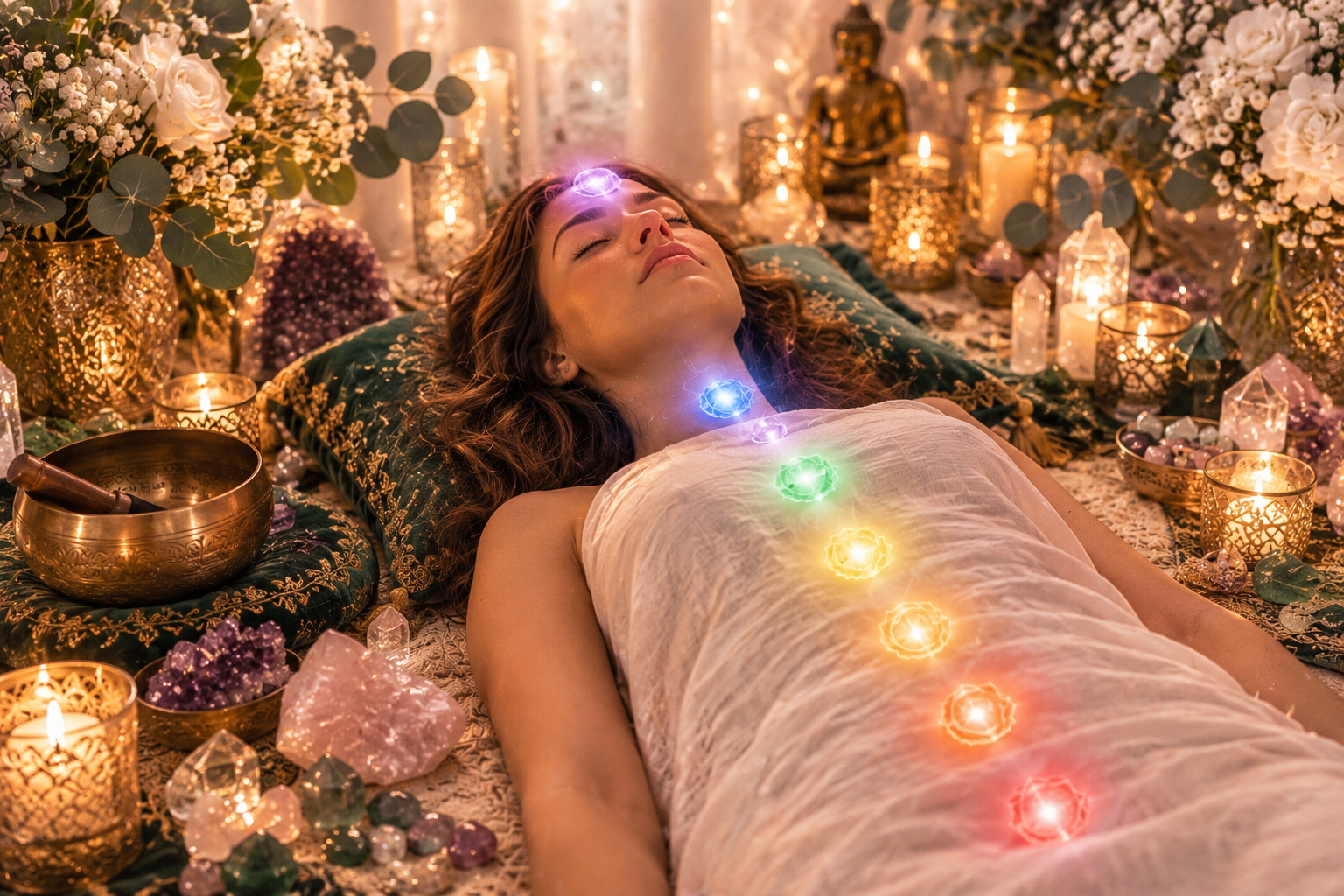
Chakra Balancing: Exploring Different Areas of Life
Chakras are described as subtle energy centers in certain spiritual traditions rooted in South Asia. Different traditions use different systems, while the familiar seven-chakra framework is widely used in contemporary spiritual wellness.
In that framework, the chakras are commonly associated with these themes:
Root chakra: grounding, stability, and belonging.
Sacral chakra: creativity, enjoyment, and emotional expression.
Solar plexus chakra: confidence, motivation, and personal choice.
Heart chakra: love, compassion, and connection.
Throat chakra: communication and authentic expression.
Third eye chakra: intuition, imagination, and perspective.
Crown chakra: spiritual meaning and connection.
Chakra balancing uses this framework to guide spiritual attention. A session may involve visualization, meditation, sound, crystals, or other practices, depending on the practitioner.
You can also use these themes as prompts for reflection without assuming that an uncomfortable feeling means an energy center is blocked.
How the Three Practices Work Together
Meditation, crystals, and chakra reflection can be combined around one clear intention.
For example, you might choose to focus on communication. In the seven-chakra framework, this theme is associated with the throat chakra.
You could begin with a few minutes of quiet breathing, then reflect on something you want to express more clearly. If you enjoy crystals, you might hold a stone you personally associate with communication or place it nearby.
The meditation gives you time to focus. The crystal provides a physical reminder. The chakra theme offers a direction for your reflection.
You don’t need to use all three every time. Some days you may prefer a simple meditation; on others, you may enjoy a more intentional spiritual ritual.
Choosing a Crystal for Your Practice
It can be easy to feel overwhelmed by lists of stones and their meanings. You don’t need a large collection or an expensive crystal to begin.
Start with a stone you already own or one whose appearance and symbolism appeal to you. If you’re exploring a particular chakra, you may choose a crystal traditionally associated with its color or spiritual themes.
For heart-centered reflection, someone might select rose quartz and focus on compassion. For grounding, they might choose a stone they associate with stability and reflect on the routines or relationships that support them.
The important part is understanding what the crystal represents to you. There is no need to worry that choosing the “wrong” stone will spoil your meditation.
A Simple Practice to Try at Home
Begin by choosing one theme you would like to explore, such as grounding, confidence, or self-expression.
Find a comfortable place to sit where you can pause for a few minutes.
Place a crystal nearby or hold it comfortably, if you want to use one.
Notice your natural breathing without forcing it to change.
Bring your chosen theme to mind.
Ask yourself one gentle, open-ended question.
Finish by identifying a small action you can take in everyday life.
If your theme is grounding, your question might be, “What would help me feel more supported this week?” Your next step could be establishing a regular routine or making time to connect with a friend.
If your theme is communication, you might ask, “What do I need to say more clearly?” Your next step could be writing down your thoughts before an important conversation.
This connects the spiritual reflection with something practical and personal.
What to Expect From a Guided Session
A guided session can introduce you to practices you may find unfamiliar and give you space to ask questions.
Before booking chakra balancing, ask the practitioner what the session includes, how long it lasts, and whether crystals, sound, meditation, or touch are involved. Approaches vary, and you should feel comfortable expressing your preferences.
You don’t need to arrive with special knowledge or a particular spiritual belief. You may simply want to explore the experience and see which parts feel meaningful to you.
There is also no required sensation or emotional response. Feeling quiet, distracted, thoughtful, or uncertain does not mean you have done something incorrectly.
Explore Spiritual Wellness at Psychic Room on King
Meditation, crystals, and chakra balancing offer different ways to approach spiritual reflection. Used together, they can create a personal ritual built around attention, symbolism, and intention.
At Psychic Room on King, Psychic Lori offers chakra balancing and intuitive guidance for those interested in exploring their spiritual path. Whether you are beginning with a few questions or looking to deepen an existing practice, you can ask about the available services and find an experience that suits your interests.
Visit Psychic Room on King at 320 King St., 2nd Floor, Charleston, South Carolina. To learn more or inquire about an appointment, call (843) 323-8620.
